VUCA, Health, and Biostatistics: India's Challenge
Article Sidebar
Main Article Content
Abstract
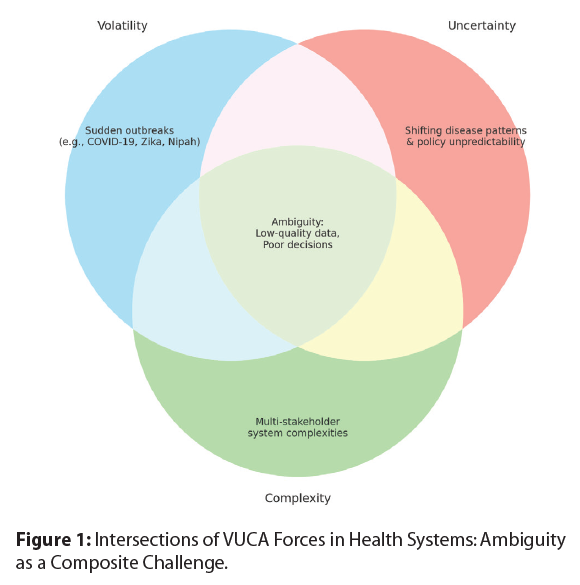
In a world, increasingly characterized by Volatility, Uncertainty, Complexity, and Ambiguity (VUCA), health systems, especially in developing countries, face significant operational and strategic challenges. This article explores how health economics, supported by biostatistics and data science, can help navigate these challenges. Using India as a case study, we examine the stress points in health financing, data infrastructure, and policy implementation. We propose a systems-thinking approach leveraging data-driven models, predictive analytics, and cost-effectiveness evaluations to build resilient and inclusive health systems. The findings underscore the crucial need for integrated, context-specific strategies to achieve health equity and efficiency in a VUCA environment.
Metrics
Article Details

This work is licensed under a Creative Commons Attribution-NonCommercial-ShareAlike 4.0 International License.
References
WHS 2025. World health statistics 2025: monitoring health for the SDGs, Sustainable Development Goals. [Internet]. Vol. 49, Choice Reviews Online. Licence: CC BY-NC-SA 3.0 IGO; 2025. 49-6620-49–6620 p. Available from: https://iris.who.int/bitstream/handle/10665/381418/9789240110496-eng.pdf?sequence=1
Economic Liberalisation in India | Economic and Political Weekly [Internet]. [cited 2025 Jul 11]. Available from: https://www.epw.in/journal/2008/26-27/special-articles/government-health-spending-india.html
Chen C, Zhou W, Cui Y, Cao K, Chen M, Qu R, et al. Global, regional, and national characteristics of the main causes of increased disease burden due to the covid-19 pandemic: time-series modelling analysis of global burden of disease study 2021. BMJ [Internet]. 2025 Jul 2 [cited 2025 Jul 11];390:e083868. Available from: https://www.bmj.com/content/390/bmj-2024-083868
Wojcik O, Mshp M, E C, Plough AL. Aligning Health and Social Systems to Promote Population Health, Well-Being, and Equity. Vol. 110, American journal of public health. 2020. p. S176–7.
Hazra DK, Pujari BS, Shekatkar SM, Mozaffer F, Sinha S, Guttal V, et al. Modelling the first wave of COVID-19 in India. PLOS Comput Biol [Internet]. 2022 Oct 1 [cited 2025 Jul 11];18(10):e1010632. Available from: https://journals.plos.org/ploscompbiol/article?id=10.1371/journal.pcbi.1010632
Chatterjee B, Mande SC. Demography, sanitation and previous disease prevalence associate with COVID-19 deaths across Indian States. Sci Rep [Internet]. 2025 Dec 1 [cited 2025 Jul 11];15(1):1–12. Available from: https://www.nature.com/articles/s41598-025-93622-0
Economic Survey 2022-23: Health not a priority? Just over 2% of GDP spent [Internet]. [cited 2025 Jul 11]. Available from: https://www.downtoearth.org.in/health/economic-survey-2022-23-health-not-a-priority-just-over-2-of-gdp-spent-87403?utm_source=chatgpt.com
CoWIN in India: The Digital Backbone for the COVID-19 Vaccination Program | Exemplars in Global Health [Internet]. [cited 2025 Jul 11]. Available from: https://www.exemplars.health/emerging-topics/epidemic-preparedness-and-response/digital-health-tools/cowin-in-india
Blanchard J; Washington R; Becker M;, Al VNMKSR et. Vision 2035 Public Health Surveillance in India, NITI AYOG [Internet]. 2020. Available from: https://www.niti.gov.in/sites/default/files/2023-03/Vision-2035-Public-Health-Surveillance-in-India.pdf
PTI. Lancet study projects US foreign aid cuts could result in over 1.4 crore preventable deaths globally [Internet]. The Economic Times, July 1, 2025. 2025. Available from: https://economictimes.indiatimes.com/news/international/global-trends/lancet-study-projects-us-foreign-aid-cuts-could-result-in-over-1-4-crore-preventable-deaths-globally/articleshow/122178516.cms?from=mdr
Anderson S. USAID Formally Shut Down – Days After Scientists Warn Closure Will Kill 2.4 Million People Every Year [Internet]. Health Policy Watch, July 2 , 2025. 2025 [cited 2025 Jul 22]. Available from: https://healthpolicy-watch.news/usaid-shut-down-lancet-millions-deaths/
Fletcher ER. WHO Budget Crisis Bigger Than Previously Thought – $2.5 Billion Gap for 2025-2027. Health Policy Watch, February 4, 2025. 2025.