Device-Associated Hospital-Acquired Infections in ICU and HDU: A Cross-Sectional Study
Article Sidebar
Main Article Content
Abstract
Background: Hospital-acquired infections (HAIs), particularly device-associated infections, continue to be a major cause of preventable morbidity and mortality in critical care settings. Intensive Care Units (ICUs) and High Dependency Units (HDUs) are especially vulnerable due to frequent use of invasive devices and prolonged hospital stays.
Objective: To determine the incidence and pattern of device-associated hospital-acquired infections in ICU and HDU settings of a tertiary care government hospital and to assess microbiological profiles and sample contamination rates.
Methods: A cross-sectional observational study was conducted over two months in the ICU and HDU of the Medicine Department. Device-days for urinary catheters, central venous lines, and ventilators were recorded. CAUTI, CLABSI, and VAP rates were calculated per 1000 device-days using standardized definitions. Microbiological culture reports were analyzed, and data were subjected to descriptive statistical analysis.
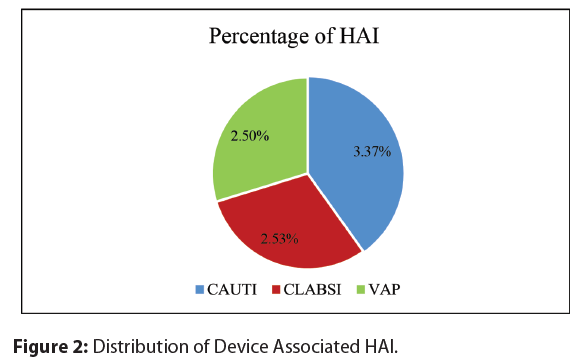
Results: Hospital-acquired infections were observed in 8.4% of admitted patients. Device-associated infection rates were CAUTI 3.37%, CLABSI 2.50%, and VAP 2.53%, with higher rates observed in ICU compared to HDU. Gram-negative organisms predominated, including Pseudomonas aeruginosa, Klebsiella pneumoniae, and Acinetobacter baumannii. Sample contamination rates were notably high, reflecting gaps in aseptic collection practices.
Conclusion: The findings highlight a substantial burden of device-associated HAIs in critical care units. Strengthening infection prevention bundles, improving sample collection practices, and reinforcing antimicrobial stewardship are essential to reduce HAI rates in resource-limited tertiary care settings.
Article Details

This work is licensed under a Creative Commons Attribution-NonCommercial-ShareAlike 4.0 International License.
References
CDC’s core infection prevention and control practices for safe healthcare delivery in all settings [Internet]. Centers for Disease Control and Prevention; [cited 2026 Feb 2]. Available from: https://www.cdc.gov/infection-control/hcp/core-practices/index.html
Report on the burden of endemic health care-associated infection worldwide [Internet]. World Health Organization; [cited 2026 Feb 2]. Available from: https://www.who.int/publications/i/item/report-on-the-burden-of-endemic-health-care-associated-infection-worldwide
Allegranzi B, Nejad SB, Combescure C, Graafmans W, Attar H, Donaldson L, et al. Burden of en-demic health-care-associated infection in developing countries: Systematic review and meta-analysis. The Lancet. 2011 Jan;377(9761):228–41. doi:10.1016/s0140-6736(10)61458-4
Klevens RM, Edwards JR, Richards CL, Horan TC, Gaynes RP, Pollock DA, et al. Estimating health care-associated infections and deaths in U.S. hospitals, 2002. Public Health Reports®. 2007 Mar;122(2):160–6. doi:10.1177/003335490712200205
Magill SS, O’Leary E, Janelle SJ, Thompson DL, Dumyati G, Nadle J, et al. Changes in prevalence of health care–associated infections in U.S. hospitals. New England Journal of Medicine. 2018 Nov;379(18):1732–44. doi:10.1056/nejmoa1801550
Patient Safety Component Manual. 2023 [Internet]. [cited 2026 Feb 2]. Available from: https://www.cdc.gov/nhsn/pdfs/validation/2023/pcsmanual_2023.pdf
Prestinaci F, Pezzotti P, Pantosti A. Antimicrobial resistance: A global multifaceted phenomenon. Pathogens and Global Health. 2015 Sept 7;109(7):309–18. doi:10.1179/2047773215y.0000000030
Baron EJ, Miller JM, Weinstein MP, Richter SS, Gilligan PH, Thomson RB, et al. A guide to utili-zation of the Microbiology Laboratory for diagnosis of infectious diseases: 2013 recommendations by the Infectious Diseases Society of America (IDSA) and the American Society for Microbiology (asm)a. Clinical Infectious Diseases. 2013 Aug 15;57(4). doi:10.1093/cid/cit278
Thakkar J, Kurup R, Laba T-L, Santo K, Thiagalingam A, Rodgers A, et al. Mobile telephone text messaging for medication adherence in chronic disease. JAMA Internal Medicine. 2016 Mar 1;176(3):340. doi:10.1001/jamainternmed.2015.7667
Pittet D, Allegranzi B, Sax H, Dharan S, Pessoa-Silva CL, Donaldson L, et al. Evidence-based model for hand transmission during patient care and the role of improved practices. The Lancet In-fectious Diseases. 2006 Oct;6(10):641–52. doi:10.1016/s1473-3099(06)70600-4
Siegel JD, Rhinehart E, Jackson M, Chiarello L. Management of multidrug-resistant organisms in health care settings, 2006. American Journal of Infection Control. 2007 Dec;35(10). doi:10.1016/j.ajic.2007.10.006
Rosenthal VD, Maki DG, Salomao R, Moreno CÁ, Mehta Y, Higuera F, et al. Device-associated nosocomial infections in 55 intensive care units of 8 developing countries. Annals of Internal Med-icine. 2006 Oct 17;145(8):582–91. doi:10.7326/0003-4819-145-8-200610170-00007