Late-Presenting Bochdalek Hernia in a 36-Year-Old: Navigating Anaesthetic Risks and Lung Isolation
Article Sidebar
Main Article Content
Abstract
Background: Congenital diaphragmatic hernia (CDH) presenting in adulthood is uncommon and often poses significant diagnostic and anaesthetic challenges. Bochdalek hernia, the most frequent variant, may remain asymptomatic for years and present later with nonspecific gastrointestinal or respiratory symptoms. We report the anaesthetic management of an adult female with late-presenting left-sided Bochdalek hernia requiring surgical repair.
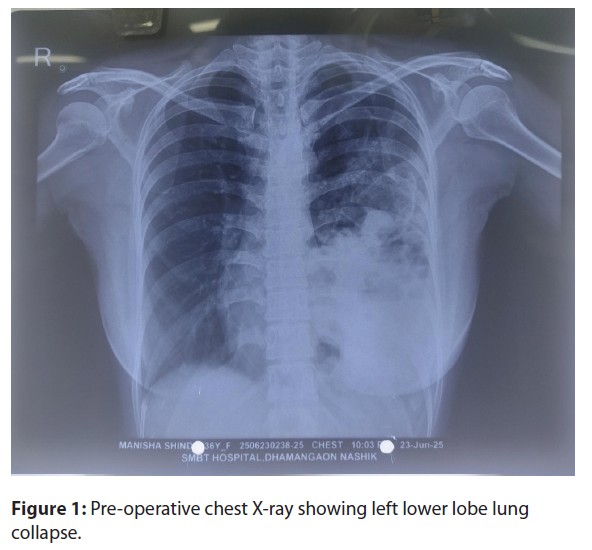
Case-Presentation: A 36-year-old female presented with abdominal pain and breathlessness for 15 days. She had a history of two lower-segment caesarean sections but no prior diagnosis of diaphragmatic defect. Pre-operative evaluation revealed NYHA Grade II dyspnoea. Chest radiography showed left lower lobe collapse, and HRCT demonstrated a posterolateral diaphragmatic defect with herniation of bowel loops and mesentery, consistent with a Bochdalek hernia. Baseline investigations and ECG were normal, and echocardiography showed an ejection fraction of 60%. Pre-operative pulmonary optimisation with Duolin and Budecort nebulisation was advised.
Anaesthesia was induced after full preparation and preoxygenation. A 35 Fr double-lumen endotracheal tube was placed for lung isolation. Invasive monitoring, including arterial line and triple-lumen central venous catheter, was instituted due to the anticipated complexity of surgery. Anaesthesia was maintained with controlled ventilation and sevoflurane. The six-hour procedure was uneventful with stable haemodynamics. At completion, the double-lumen tube was exchanged for a single-lumen tube, and the patient was transferred intubated to the SICU for elective postoperative ventilation. She was successfully extubated on postoperative day three, and imaging confirmed good lung expansion.
Conclusion: Adult Bochdalek hernia requires meticulous anaesthetic planning, lung isolation strategies, and vigilant perioperative monitoring to ensure favourable outcomes.
Metrics
Article Details

This work is licensed under a Creative Commons Attribution-NonCommercial-ShareAlike 4.0 International License.
References
Taheriniya A, Maghsoudi MR, Chaghamirzayi P. Incidental discovery of a giant congenital diaphragmatic hernia in an adult: A case report and literature review. International Journal of Surgery Case Reports. 2024 Aug;121:109969.
Pranata H, Kurniyanta P. Anesthesia Management of Congenital Diaphragmatic Hernia in Neonates. Bali Journal of Anesthesiology. 2021 Jan;5(1):53–6.
Kulkarni K. Anesthetic Management of Adult diaphragmatic Hernia for Laparoscopic Repair: A Case Report. 2021;
Waindeskar V, Francis T, Sinha D, Jain A, Kaushal A, Tejpal S. Anesthetic Management of Adult Diaphragmatic Hernia for Primary Repair with Colostomy: A Case Report. Indian Journal of Trauma and Emergency Pediatrics. 2022;14(2).
D DrS, Priya DrM, Lakshmi Dr. Anaesthetic management of diaphragmatic hernia in elderly woman: A case report. Int J Med Anesthesiology. 2021 Oct 1;4(4):24–6.
Masuya R, Nakame K, Munakata S, Takeno S, Nanashima A, Ieiri S. A case of late-presenting congenital diaphragmatic hernia diagnosed at 5 years with acute abdomen. surg case rep. 2024 July 30;10(1):177.
Chan SKT, Tan DJ, Aman MDM. Case report: anaesthetic and surgical management of a diaphragmatic rupture with tension pneumothorax and iatrogenic bowel perforation in an undiagnosed Bochdalek hernia patient. BMC Anesthesiol. 2022 Dec;22(1):195.