The Ubiquity of Electronic Gadgets and Sleep Patterns among Undergraduate Health Sciences Students: A Descriptive and Inferential Analysis
Article Sidebar
Main Article Content
Abstract
Background: The increasing use of electronic gadgets among students has raised concerns about their potential impacts on sleep quality and duration. This study sought to characterize the extent of gadget usage, describe sleep patterns, and identify commonly reported sleep-influencing factors among a cohort of undergraduate health science students in India.
Methods: A cross-sectional survey was conducted in 2024 among 101 undergraduate students from medical and allied health disciplines at a tertiary institution in Ghoti Kh, Maharashtra, India. The survey collected self-reported data on daily gadget usage, pre-bedtime device activities, sleep duration, and subjective sleep quality on a 1-5 scale. Descriptive statistics, including means, standard deviations, and frequencies, were used to present the findings.
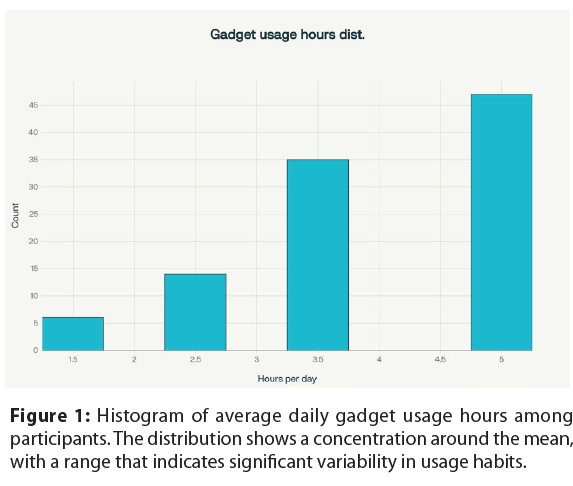
Results: Participants reported a mean daily gadget usage of 3.79 hours (SD=1.15) and a mean sleep duration of 6.66 hours (SD=0.91). The mean self-rated sleep quality was 3.54 out of 5 (SD=0.92), with a "fair-good" rating being the most common. Social media browsing and watching videos were the most frequent pre-bedtime activities. Academic stress and workload were cited as significant contributors to poor sleep, alongside late-night gadget use. The distribution of daily gadget usage and sleep duration is visualized in histograms.
Conclusion: This descriptive analysis highlights the substantial daily gadget use and frequent pre-bedtime engagement among health science students in this Indian context. The average sleep duration falls below recommended guidelines, underscoring a public health concern. The findings emphasize the need for targeted sleep hygiene and time-management interventions to improve sleep health in this student population.
Metrics
Article Details

This work is licensed under a Creative Commons Attribution-NonCommercial-ShareAlike 4.0 International License.
References
Cain N, Gradisar M. Electronic media use and sleep in school-aged children and adolescents: A review. Sleep Med. 2010.
Nagata JM et al. Screen time use among US adolescents during the COVID-19 pandemic. JAMA Pediatr. 2022.
Browning MHEM et al. Psychological impacts from COVID-19 among university students: Risk factors and coping strategies. PLoS One. 2021.
Hale L, Guan S. Screen time and sleep among school-aged children and adolescents: A systematic literature review. Sleep Med Rev. 2015.
Exelmans L, Van den Bulck J. Bedtime mobile phone use and sleep in adults. Social Science & Medicine. 2016.
Gradisar M et al. The sleep and technology use of Americans: findings from the National Sleep Foundation Sleep in America Poll. J Clin Sleep Med. 2013.
Chang A-M et al. Evening use of light-emitting eReaders negatively affects sleep, circadian timing, and next-morning alertness. Proc Natl Acad Sci U S A. 2015.
LeBourgeois MK et al. Light exposure and the sleep-wake cycle: Influence on melatonin and circadian phase. Sleep. 1997.
Giri PA et al. Study of sleep habits and sleep problems among undergraduate medical students of a tertiary care teaching hospital in India: A cross-sectional study. Natl J Community Med. 2019.
Alotaibi AD et al. The relationship between sleep quality, stress, and academic performance among medical students. Sleep Breath. 2020.
Medic G, Wille M, Hemels ME. Short- and long-term health consequences of sleep disruption. Nat Sci Sleep. 2017.
Walker MP. The role of sleep in cognition and emotion. Ann N Y Acad Sci. 2009.
Lund HG et al. Sleep patterns and predictors of disturbed sleep in a large population of college students. J Adolesc Health. 2010.
Hulley SB, Cummings SR. Designing Clinical Research. 4th ed. Lippincott Williams & Wilkins, 2013.
Hirshkowitz M et al. National Sleep Foundation's updated sleep duration recommendations: final report. Sleep Health. 2015.