Presence of Atopy in Bronchiectatic Patients: A not-so Coincidental Finding
Article Sidebar
Main Article Content
Abstract
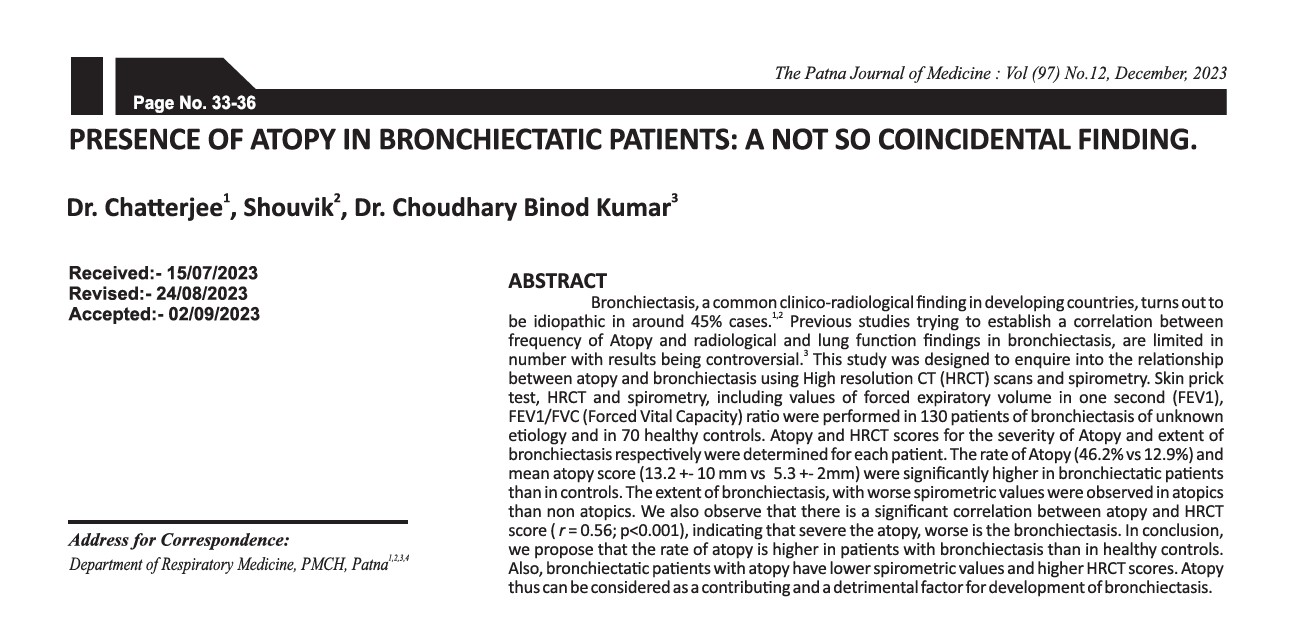
Bronchiectasis, a common clinico-radiological finding in developing countries, turns out to be idiopathic in around 45% cases.1,2 Previous studies trying to establish a correlation between frequency of Atopy and radiological and lung function findings in bronchiectasis, are limited in number with results being controversial.3 This study was designed to enquire into the relationship between atopy and bronchiectasis using High-resolution CT (HRCT) scans and spirometry. Skin prick test, HRCT and spirometry, including values of forced expiratory volume in one second (FEV1), FEV1/FVC (Forced Vital Capacity) ratio were performed in 130 patients of bronchiectasis of unknown etiology and in 70 healthy controls. Atopy and HRCT scores for the severity of Atopy and extent of bronchiectasis respectively were determined for each patient. The rate of Atopy (46.2% vs 12.9%) and mean atopy score (13.2 +- 10 mm vs 5.3 +- 2mm) were significantly higher in bronchiectatic patients than in controls. The extent of bronchiectasis, with worse spirometric values, was observed in atopics than non-atopics. We also observe a significant correlation between atopy and HRCT score ( r= 0.56; p<0.001), indicating that the more severe the atopy, the worse the bronchiectasis. In conclusion, we propose that the rate of atopy is higher in patients with bronchiectasis than in healthy controls. Also, bronchiectatic patients with atopy have lower spirometric values and higher HRCT scores. Atopy thus can be considered as a contributing and a detrimental factor for the development of bronchiectasis.
Article Details

This work is licensed under a Creative Commons Attribution-NonCommercial-ShareAlike 4.0 International License.