Comparison of Effectiveness of Conservative versus Surgical Management for Displaced Mid-Shaft Clavicle Fractures in a Tertiary Care Hospital in Eastern India
Article Sidebar
Main Article Content
Abstract
Background: Fractures of the clavicle, particularly mid-shaft fractures, are prevalent injuries often resulting from high-energy impacts. The management of these fractures is crucial in a tertiary care setting in Eastern India due to their high incidence and impact on functional outcomes. Traditional treatment options include conservative and surgical approaches, each with its advantages and disadvantages, leading to ongoing debates regarding their effectiveness.
Objective: To evaluate and compare the effectiveness of conservative versus surgical management for displaced mid-shaft clavicle fractures.
Methods: A comparative observational study was conducted involving 100 patients diagnosed with displaced mid-shaft clavicle fractures. Patients were divided into two groups: Group A received non-operative management, while Group B underwent surgical intervention using a locking compression plate (LCP). Inclusion and exclusion criteria were established, and data were collected on demographic details, clinical assessments, and radiological examinations. Outcome measures included union time, non-union rates, functional scores (UCLA and DASH), and complications.
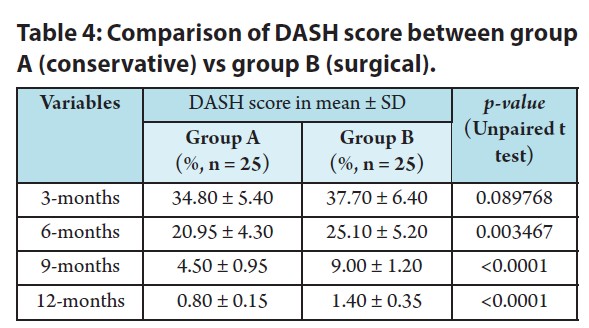
Result: The study found that surgical treatment resulted in significantly faster union times compared to conservative management (60% of surgical patients united in 2-3 months vs. 28% of conservative patients, p = 0.045). However, non-union rates were similar between groups (12% in conservative vs. 4% in surgical, p = 0.61). Functional outcomes, as measured by UCLA scores, showed no significant differences at any time point, while DASH scores indicated better functional results for conservative treatment at later stages (p<0.0001).
Conclusion: Surgical treatment for clavicle fractures leads to faster union times but does not significantly improve functional outcomes compared to conservative treatment. Conservative management may provide better long-term functionality, suggesting that treatment choice should consider patient priorities regarding recovery speed versus functional improvement.