AETCOM to Humanistic Competence: Strengthening the Affective Core of Indian Medical Education
Article Sidebar
Main Article Content
Abstract
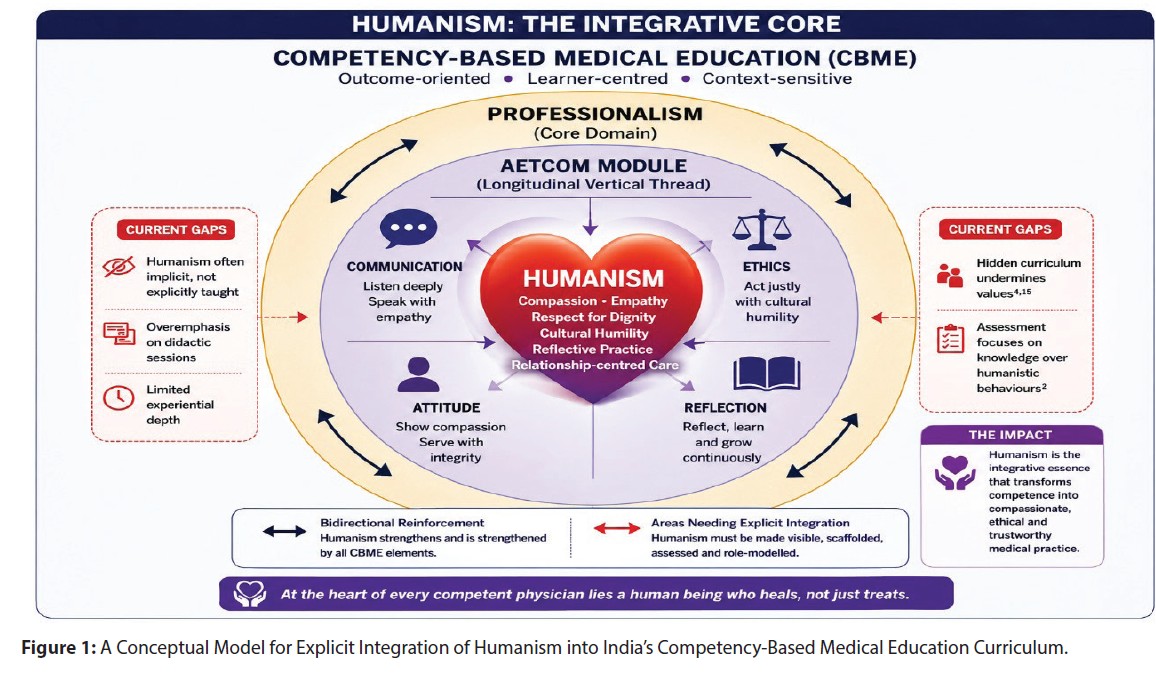
Background: India’s Competency-Based Medical Education (CBME) framework, introduced through GMER 2019, includes the longitudinal Attitude, Ethics and Communication (AETCOM) module to strengthen the affective domain. However, humanism—encompassing compassion, empathy, cultural humility, reflective practice, and relationship-centred care—remains largely implicit rather than explicitly articulated within this structure.
Summary: This Viewpoint critically examines the evolution and achievements of AETCOM while highlighting gaps in current
implementation, including limited experiential depth, suboptimal assessment of humanistic behaviours, and the erosive influence of
the hidden curriculum. Drawing on global scholarship (e.g., Epstein & Hundert, Branch) and Indian policy documents, it argues that
humanism constitutes an essential missing dimension that should be deliberately integrated into AETCOM and the broader CBME
framework to produce more compassionate and resilient Indian Medical Graduates.
Recommendations: Practical strategies include explicit mapping of humanistic competencies, incorporation of narrative medicine
and reflective portfolios, reformed assessment using multi-source humanistic rubrics, and targeted faculty development. A conceptual
model and comparative table illustrate the proposed integration.
Conclusion: Explicit recognition and embedding of humanism within AETCOM will enhance the humanistic core of Indian medical
education, ultimately improving patient care, professional fulfilment, and equity in diverse clinical contexts.
Metrics
Article Details

This work is licensed under a Creative Commons Attribution-NonCommercial-ShareAlike 4.0 International License.
References
National Medical Commission. Regulations on Graduate Medical Education (Amendment), 2019. NMC; 2019.
Singh T, Sood R. The new competency-based medical education: Where are we now? Indian Pediatr. 2020;57(11):1001-2.
Medical Council of India. At titude, Ethics and Communication (AETCOM) Module for Undergraduate Medical Education. NMC; 2019. Available from: https://www.nmc.org.in/wp-content/uploads/2020/01/AETCOM_book.pdf.
Chacko TV. Developing Humanistic Competencies Within the Competency-Based Medical Education Framework. Indian Pediatr. 2020;57(11):1060-6.
Medical Council of India. Competency Based Undergraduate Curriculum. NMC; 2019.
National Medical Commission. GMER 2023 Updates. NMC; 2023.
Issues impeding satisfactory outcomes with the competency-based medical education program. Natl Med J India. 2024.
Impact of AETCOM module about autonomy, empathy and equanimity. Indian J Physiol Pharmacol. 2024.
Perceptions of Attitude, Ethics, and Communication (AETCOM) Module. BMC Med Educ. 2024.
Arnold L, Stern DT. What is medical professionalism? In: Stern DT, editor. Measuring Medical Professionalism. Oxford University Press; 2006.
Branch WT Jr. Teaching professional and humanistic values. Patient Educ Couns. 2015;98(2):162-7.
Nurturing humanism and professionalism in a clinical setting. Indian J Med Ethics. 2024.
Epstein RM, Hundert EM. Defining and assessing professional competence. JAMA. 2002;287(2):226-35.
The Hidden Curricula of Medical Education: A Scoping Review. Acad Med. 2018;93(4):648-56.
Medical education in India: past, present, and future. APIK J Int Med. 2019.
Epstein RM. Assessment in Medical Education. N Engl J Med. 2007;356(4):387-96.