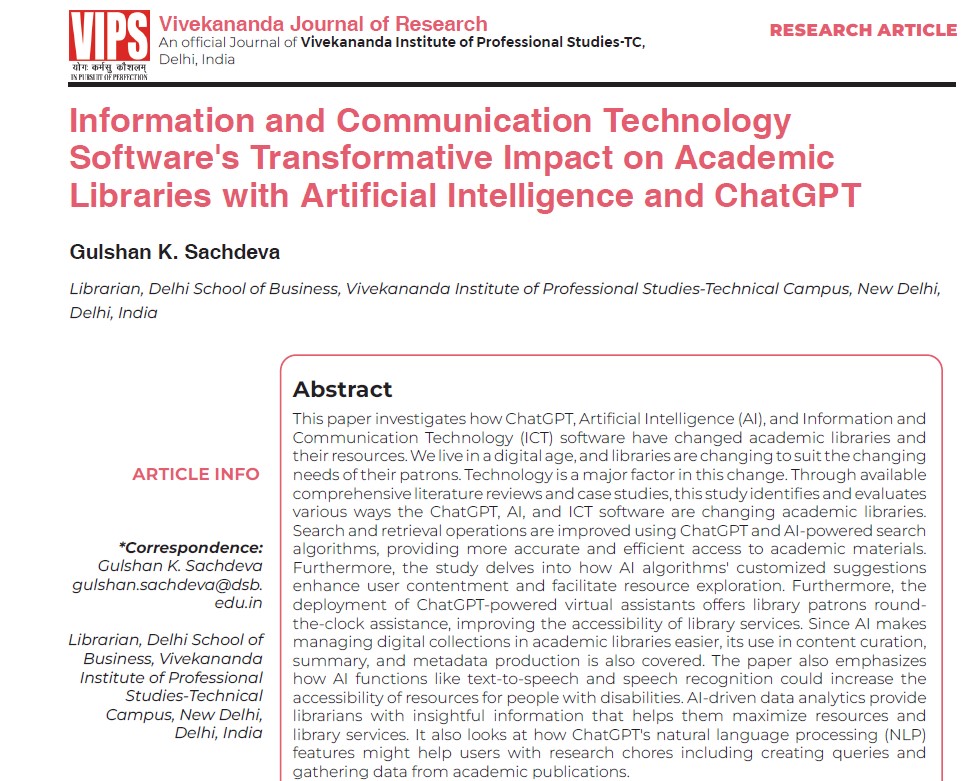
Information and Communication Technology Software's Transformative Impact on Academic Libraries with Artificial Intelligence and ChatGPT
Article Sidebar
Main Article Content
Abstract
This paper investigates how ChatGPT, Artificial Intelligence (AI), and Information and Communication Technology (ICT) software have changed academic libraries and their resources. We live in a digital age, and libraries are changing to suit the changing needs of their patrons. Technology is a major factor in this change. Through available comprehensive literature reviews and case studies, this study identifies and evaluates various ways the ChatGPT, AI, and ICT software are changing academic libraries.
Article Details

This work is licensed under a Creative Commons Attribution-NonCommercial-ShareAlike 4.0 International License.
CC BY-NC-SA 4.0
Attribution Non-Commercial Share-alike 4.0 International
Visit here for more details: https://creativecommons.org/licenses/by-nc-sa/4.0/
References
Ahmad, P., & Yaseen, M. (2009). The role of the library and information science professionals as managers: a comparative analysis.
https://digitalcommons.unl.edu/cgi/viewcontent.cgi? article=1108&context=ejasljournal.
Aljanabi, M. (2023). Chatgpt: Future directions and open possibilities. Mesopotamian Journal of Cyber Security, 16–17. https://doi.org/10.58496/mjcs/2023/003.
Bishop, C. M. (1994). Neural networks and their applications. Review of Scientific Instruments, 65, article 1803. https://doi.org/10.1063/1.114483.
Budzianowski, P., & Vulić, I. (2019). Hello, it's GPT-2--how can I help you? towards the use of pretrained language models for task-oriented dialogue systems. arXiv. https://doi.org/10.48550/arXiv.1907.05774.
Chen, X. (2023). ChatGPT and Its Possible Impact on Library Reference Services. Internet Reference Services Quarterly, 1-9.
Cherian, A., Peng, K. C., Lohit, S., Smith, K., & Tenenbaum, J. B. (2022). Are Deep Neural Networks SMARTer than Second Graders? arXiv.
https://doi.org/10.48550/arXiv.2212.09993.
Cox, C., & Tzoc, E. (2023). CHATGPT: Implications for academic libraries. College & Research Libraries News, 84(3). https://doi.org/10.5860/crln.84.3.99.
Dvorak, C. (2023, February 23). The future of AI: OpenAI’s CHATGPT model. Neudesic. https://www.neudesic.com/blog/the-future-of-ai-openais-chatgpt-model/
Fernandez, P. (2023). “Through the looking glass: envisioning new library technologies” AI-text generators as explained by ChatGPT. Library Hi Tech News.
Gao, J., Zhao, H., Yu, C., & Xu, R. (2023, March 9). Exploring the feasibility of CHATGPT for event extraction. arXiv.org. https://arxiv.org/abs/2303.03836
Kirtania, D. K., & Patra, S. K. (2023). OpenAI ChatGPT Generated Content and Similarity Index: A study of selected terms from the Library & Information Science (LIS) discipline. https://www.qeios.com/read/FO1CP6
Lund, B. D., & Wang, T. (2023). Chatting about ChatGPT: how may AI and GPT impact academia and libraries? Library Hi Tech News.
Panda, S., & Kaur, N. (2023). Exploring the viability of ChatGPT as an alternative to traditional chatbot systems in library and information centers. Library Hi Tech News.
Verma, M. (2023). Novel Study on AI-Based Chatbot (ChatGPT) Impacts on the Traditional Library Management.
Wikipedia. “ChatGPT.” In Wikipedia. Wikimedia Foundation, Inc, January 20, 2023. https://en.wikipedia.org/w/index.php?title=ChatGPT