Food Delivery Apps and Decision Making: Navigating Information Overload among College Students in Delhi
Article Sidebar
Main Article Content
Abstract
The advent of food delivery applications like Zomato and Swiggy has revolutionized the way individuals access and consume food. College students, especially those living in urban cities like Delhi, have easy access to internet connectivity and hence to these food delivery platforms. Such applications provide users access to an extensive variety of available options; from restaurants to cuisines and, even reviews and ratings. However, this abundance of choice can sometimes overwhelm users, leading to information overload, a state wherein users often encounter a surplus of information, leading to decision-making challenges and cognitive strain. The main objective of the paper is to find out whether food delivery applications like Zomato and Swiggy contribute to information overload among college students in Delhi. An online survey was conducted to capture various dimensions of information overload, including the sheer volume of options available on food delivery apps, the complexity of decision-making etc. The study’s framework is based on Individual Differences Theory and Uses and Gratifications Theory as they provide the conceptual base of the study.
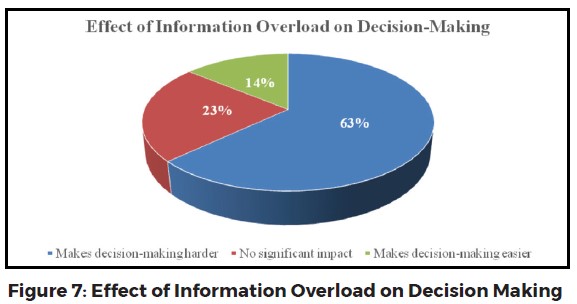
The study has revealed that there is a prevalence of information overload among the youth while using food delivery applications like Zomato and Swiggy. The study also reveals that this abundance of information complicates the decision-making process when ordering food. The findings of this research will contribute to a deeper understanding of the complex dynamics between technology, information abundance, and consumer behaviour in the context of food delivery applications.
Article Details

This work is licensed under a Creative Commons Attribution-NonCommercial-ShareAlike 4.0 International License.
CC BY-NC-SA 4.0
Attribution Non-Commercial Share-alike 4.0 International
Visit here for more details: https://creativecommons.org/licenses/by-nc-sa/4.0/
References
● Alyouzbaky, Bassam & Duriad, Rasha. (2022). The Effect of Information Overload, and Social Media Fatigue on Online Consumers Purchasing Decisions: The Mediating Role of Technostress and Information Anxiety. 12. 195-220. 10.33168/JSMS.2022.0209.
● Chaudhary, A. (2023, September 25). FNB news - "With the rise of delivery apps, restaurants have broader reach" | FNB news. Food & Beverage News. https://www.fnbnews.com/Interview/-with-the-rise-of-delivery-apps-restaurants-have-broader-reach-74460
● Chavda, V. N., & Pandya, P. R. (2017). A STUDY ON IMPACT OF SOCIAL NETWORKING SITES ON COLLEGE STUDENTS’ CONSUMPTION PATTERNS. Towards Excellence, 9(1). http://dx.doi.org/10.37867/TE090101
● Festinger, L. (1957). A theory of cognitive dissonance. : Stanford University Press.
● Gao J, Zheng P, Jia Y, Chen H, Mao Y, et al. (2020) Mental health problems and social media exposure during COVID-19 outbreak. PLOS ONE 15(4): e0231924. https://doi.org/10.1371/journal.pone.0231924
● Katz, E. (1959). Mass Communications Research and the Study of Popular Culture: An Editorial Note on a Possible Future for this Journal. Studies in Public Communication, 2, 1-6.
● Lovink, G. (2013, May). After the Social Media Hype: Dealing with Information Overload - Journal #45 May 2013. Retrieved from https://www.e-flux.com/journal/45/60109/after-the-social-media-hype-dealing-with-information-overload
● NEW MEDIA | meaning in the Cambridge English dictionary. (n.d.). Retrieved from https://dictionary.cambridge.org/dictionary/english/new-media
● Pijpers, G. (2010). Information Overload: A System for Better Managing Everyday Data. Hoboken, NJ: John Wiley & Sons.
● Renjith, R. (2017). The Effect of Information Overload in Digital Media News Content. Communication and Media Studies, 6(1), 73-85.