Evaluating the Impact of Government Schemes on Financial Inclusion and Poverty Alleviation
Article Sidebar
Main Article Content
Abstract
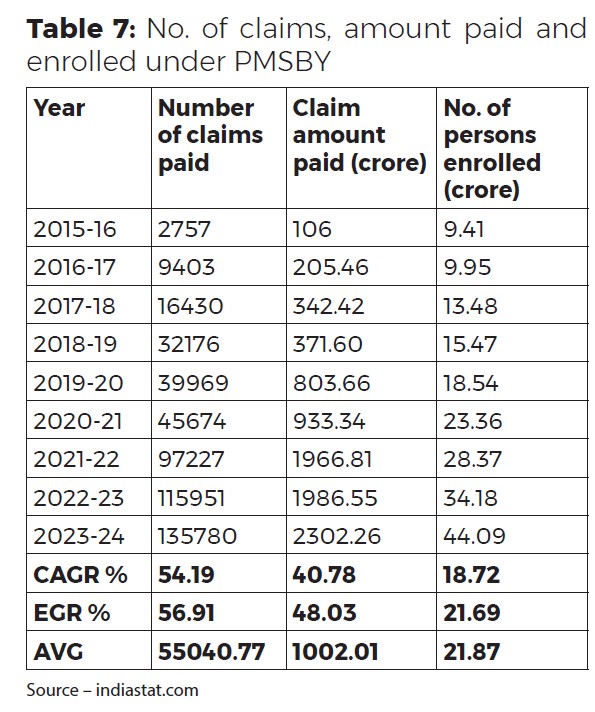
Financial inclusion is a process of providing basic financial services to the weaker sections of society. Nearly 7% of the world population, which means 600 million people still struggle in extreme poverty. Financial inclusion schemes help to uplift BPL families from poverty such as MGNREGA, APY, PMJDY and PMMY etc. The paper indicates that India has witnessed rapid progress in financial inclusion. The PMJDY scheme successfully engaged 53 crore people in banking services. The MGNREGA scheme reflects efforts to expand employment opportunities. PMJJBY, PMSBY and APY schemes provide future benefits and insurance in old age to the beneficiaries. These schemes significantly contributed to financial inclusion by providing a large population with a reliable pension, future benefits, life insurance, etc at an affordable cost. India is a fast-growing economy and according to the financial inclusion index, it improved from 53.9 to 56.4 in 2021. This improvement in the index is possible with these initiatives which taken by banks and the government. The growth rate of financial inclusion schemes is calculated by CAGR and EGR statistical methods.
The data was collected from the period 2014-2024 for every financial inclusion scheme. The paper suggests that continuing innovation and increasing outreach of schemes are maximizing the impact of schemes and achieving inclusive growth of the economy.
Article Details

This work is licensed under a Creative Commons Attribution-NonCommercial-ShareAlike 4.0 International License.
CC BY-NC-SA 4.0
Attribution Non-Commercial Share-alike 4.0 International
Visit here for more details: https://creativecommons.org/licenses/by-nc-sa/4.0/