The Role of Forgiveness as a Therapeutic Measure in Adult Romantic Relationships
Article Sidebar
Main Article Content
Abstract
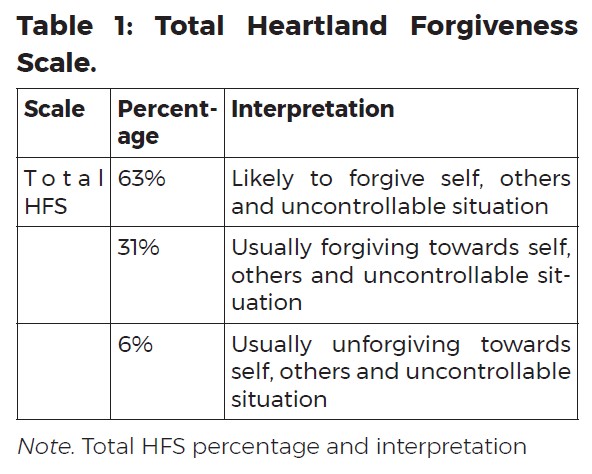
The purpose of this study is to look into how forgiveness can be used as a therapeutic strategy in romantic relationships between adults. The study used a cross-sectional mixed technique that combined quantitative and qualitative evaluations. Participants had to be in a romantic relationship or have been in one in the past, and they had to be between the ages of 20 and 30. The Heartland Forgiveness Scale and self-drafted semi-structured interviews were used to collect data from the participants. By examining and contrasting the two research, their congruence was found. Sixty-three percent of people forgive themselves, other people, and their situations in general, according to the quantitative data set. According to subscales, 52% of respondents forgive themselves, 53% forgive others, and 64% forgive uncontrollable events. The qualitative study, on the other hand, concentrated on the biopsychosocial setting, psychological cost, concrete modalities, and link building, highlighting the significance of contextual and individual aspects with regard to the empirical evidence of a person's capacity for forgiveness.
Article Details

This work is licensed under a Creative Commons Attribution-NonCommercial-ShareAlike 4.0 International License.
CC BY-NC-SA 4.0
Attribution Non-Commercial Share-alike 4.0 International
Visit here for more details: https://creativecommons.org/licenses/by-nc-sa/4.0/
References
Çelik, S. B. (2017, December 6). The role of forgiveness on subjective well-being of university students in their romantic relationships. Üniversite öğrencilerinin romantik ilişkilerinde affetmenin öznel iyi oluşları üzerindeki rolü. https://www.j-humansciences.com/ojs/index.php/IJHS/article/view/487
Griffin, B.J., Worthington, E.L., Lavelock, C.R., Wade, N.G., Hoyt, W.T. (2015).
Forgiveness and Mental Health. In: Toussaint, L., Worthington, E., Williams, D. (eds) Forgiveness and Health. Springer, Dordrecht. https://doi.org/10.1007/978-94-017-9993-5_6
Kato, T. (2016). Effects of partner forgiveness on romantic break-ups in dating relationships: A longitudinal study. Personality and Individual Differences, 95, 185–189. https://doi.org/10.1016/j.paid.2016.02.050
Kimmes, J. G., & Durtschi, J. A. (2016). Forgiveness in romantic relationships: the roles of attachment, empathy, and attributions. Journal of Marital and Family Therapy, 42(4), 645–658. https://doi.org/10.1111/jmft.12171
KV, K., & Nair, B. P. (2024). Attachment Patterns, Dispositional Forgiveness, and Perceived Social-Support among Emerging Adults. JOURNAL OF PSYCHOSOCIAL RESEARCH, 19(1), 73–81.
https://doi.org/10.32381/jpr.2024.19.01.8
Masaryková, M, Záhorcová, L., & Dršťáková, Ž., (2023). Forgiveness, its factors, and unforgivable acts in romantic relationships: A mixed‐methods study. Personal Relationships, 30(2), 471–500. https://doi.org/10.1111/pere.12471
Karremans, J. C., & Van Lange, P. a. M. (2004). Back to caring after being hurt: the role of forgiveness. European Journal of Social Psychology, 34(2), 207–227. https://doi.org/10.1002/ejsp.192
Ramos & Van Tongeren, D. R., Green, J. D., Hook, J. N., Davis, D. E., Davis, J. L., M. (2014). Forgiveness Increases Meaning in Life. Social Psychological and Personality Science, 6(1), 47-55. https://doi.org/10.1177/1948550614541298
Sandage, S. J., & Jankowski, P. J. (2010). Forgiveness, spiritual instability, mental health symptoms, and well-being: Mediator effects of differentiation of self. Psychology of Religion and Spirituality, 2(3), 168–180. https://doi.org/10.1037/a0019124
Sengupta, P., Rai, V. & Mohanty, A. Forgive and Forego? Exploring Interpersonal Forgiveness in Non-Reconciled Relationships Among Young Adults. Psychol Stud (2024). https://doi.org/10.1007/s12646-024-00813-2
Thompson, L. Y., & Synder, C. R. (1999). Heartland Forgiveness Scale (HFS). https://static1.squarespace.com/static/562403d2e4b0a77217f38772/t/5e1f5ee0dd0f253cce34d9a3/1579114209095/HFS-with-Scoring-and-Interpretation.pdf