Sacred Spaces, Silenced Voices: Buddhist Nationalism and Tamil Spatial Rights in Sri Lanka’s Tea Plantations
Article Sidebar
Main Article Content
Abstract
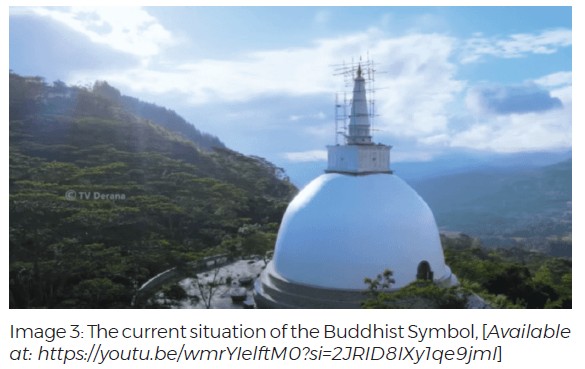
When a gleaming modern Buddhist temple rose on the misty hills of ‘Hanthana’ Tea Plantation in 2017, it promised spiritual renewal and economic prosperity through religious tourism. For the Tamil families who had lived and worked on these lands for generations, however, the temple’s construction marked the beginning of unprecedented exclusion from their own spaces. The central research problem explores how the establishment of a modern religious symbol (Sandagiri Maha Seya) on plantation land affects the spatial rights (social and cultural) and economic opportunities of Tamil workers in tea plantations. The study was conducted at Hanthana Uduwelawatta Tea Plantation, Kandy District in 2025. A qualitative-dominant mixed-methods design was employed, utilizing a purposive sampling method to select participants representing diverse economic and social positions within the plantation community. Data collection included semi-structured interviews (with 27 participants) alongside spatial mapping, participant observation, and document analysis to ensure methodological triangulation. The collected data were analyzed through thematic analysis, supported by interpretive coding to uncover recurring themes related to informal economic practices, class transformation, and spatial mobility. Interpretation focused on linking everyday livelihood practices to broader structures of urban political economy, revealing how economic advancement occurs through informal but organized strategies. Results show that residents engage in quiet capitalist mechanisms through three interconnected processes: (1) spatial entrepreneurialism, leveraging location advantages near commercial nodes; (2) social and cultural capital mobilization, enhancing class positioning through education and networks; and (3) symbolic capital manipulation, using visible social markers to assert respectability and upward mobility within marginalized spaces. The conclusion argues that ‘Quiet Capitalism’ extends Bayat’s ‘quiet encroachment’ and Bourdieu’s capital theory by revealing how marginalized urban residents convert spatial, cultural, and social resources into sustained economic advancement. The findings emphasize that informal settlements such as ‘Hanthana’ are economically productive and socially transformative spaces deserving institutional recognition, infrastructural investment, and inclusive urban policy. The study contributes to political geography and postcolonial studies by theorizing ‘spatial hegemony’: the deployment of religious symbolism to legitimize exclusionary spatial practices.
Article Details

This work is licensed under a Creative Commons Attribution-NonCommercial-ShareAlike 4.0 International License.
CC BY-NC-SA 4.0
Attribution Non-Commercial Share-alike 4.0 International
Visit here for more details: https://creativecommons.org/licenses/by-nc-sa/4.0/