Biofortification: An Ideal Approach for Nutritional Upliftment
Article Sidebar
Main Article Content
Abstract
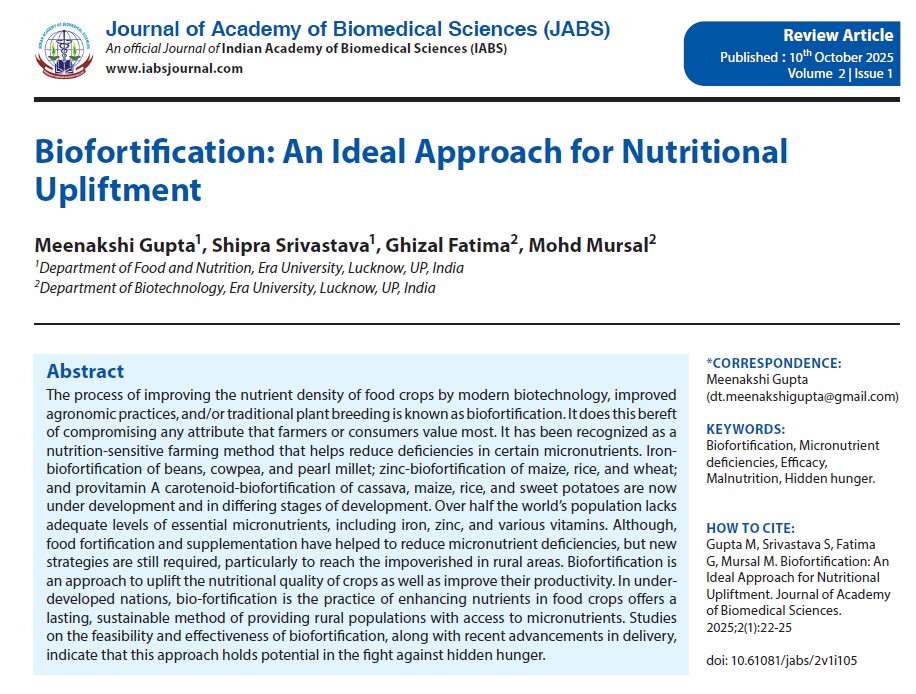
Biofortification is the process of increasing the nutrient density of food crops using conventional plant breeding, enhanced agronomic techniques, and/or contemporary biotechnology. It does this without compromising any attribute that farmers or consumers value most. It is acknowledged as a nutrition-sensitive agricultural strategy that assists in minimizing micronutrient Deficiencies. Pro-vitamin A carotenoid-biofortification of cassava, maize, rice, and sweet potatoes; zinc-biofortification of maize, rice, and wheat; and iron-biofortification of beans, cowpea, and pearl millet are presently being developed and at varying degrees of progress. More than half of the world's population suffers from deficiencies of numerous micronutrients like iron, zinc, and vitamins. Although food fortification and supplementation have helped to reduce micronutrient deficiencies but new strategies are still required, particularly to reach the impoverished in rural areas. Biofortification is an approach to uplift nutritional quality of crops as well as improve their productivity. In underdeveloped nations, biofortification—the practice of breeding nutrients into food crops offers a long-term, sustainable method of giving rural populations access to micronutrients. Studies on the feasibility and effectiveness of biofortification, along with recent advancements in delivery, indicate that this approach holds potential in the fight against hidden hunger.
Article Details

This work is licensed under a Creative Commons Attribution-NonCommercial-ShareAlike 4.0 International License.
The Journals licensing terms of CC-BY-NC-SA 4.0 speaks that you are free to Share (copy and redistribute the material in any medium or format), Adapt (remix, transform, and build upon the material) under proper terms of Attribution (You must give appropriate credit, provide a link to the license, and indicate if changes were made. You may do so in any reasonable manner, but not in any way that suggests the licensor endorses you or your use.), NonCommercial (You may not use the material for commercial purposes.), ShareAlike (If you remix, transform, or build upon the material, you must distribute your contributions under the same license as the original.) and No additional restrictions (You may not apply legal terms or technological measures that legally restrict others from doing anything the license permits.)