Vitamin C Insufficiency in India: An Underestimated Public Health Concern
Article Sidebar
Main Article Content
Abstract
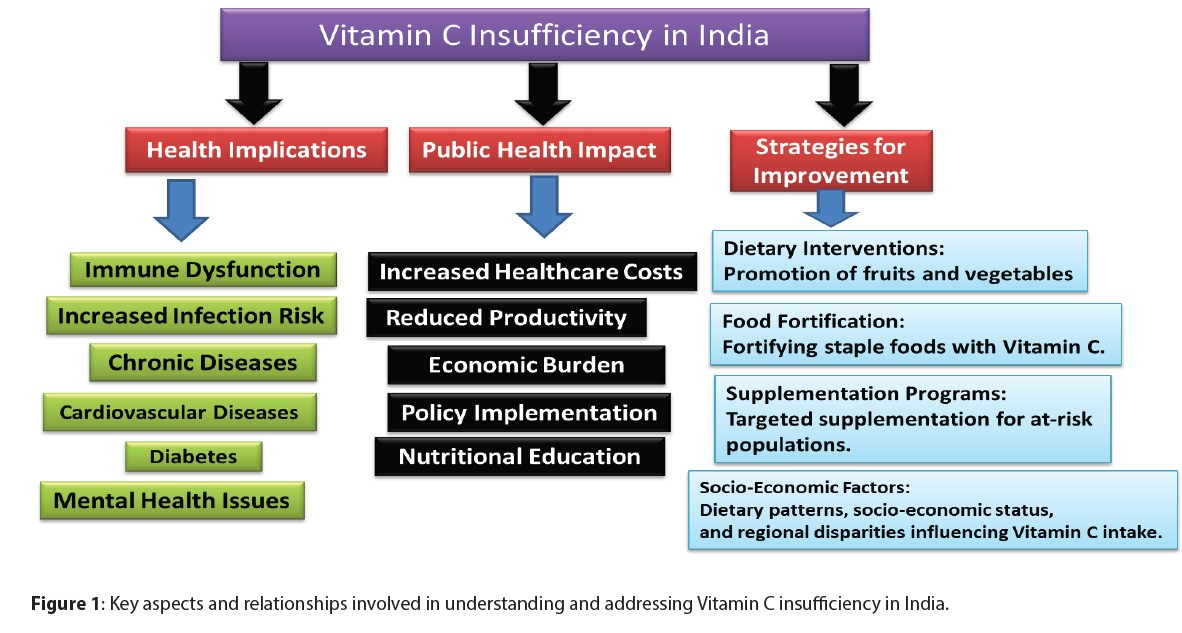
Vitamin C insufficiency is a pressing yet frequently underestimated public health concern in India. Vitamin C, essential for collagen synthesis, immune function, and also antioxidant defense, is found to be deficient in the majority of the Indian population. Recent studies reveal that around 30% of individuals in India experience Vitamin C insufficiency primarily due to poor dietary intake and limited access to fresh fruits and vegetables. The traditional Indian diets, like cereals and pulses, lack sufficient levels of Vitamin C-rich foods, exacerbating the problem. The health consequences of Vitamin C deficiency include scurvy, impaired wound healing, elevated susceptibility to infections, and a heightened risk of chronic diseases such as cancers and cardiovascular disorders. These health issues not only affect individual well-being but also impose an economic burden on the healthcare system and productivity. Addressing this public health concern requires a multi-faceted approach involving dietary diversification, increased availability of Vitamin C-rich foods, and public health campaigns aimed at raising awareness. Additionally, fortification of staple foods and targeted supplementation programs could significantly reduce deficiency rates. Government initiatives and collaborations with non-governmental organizations are essential for implementing effective interventions. By tackling Vitamin C insufficiency, India can improve its overall public health outcomes and reduce the associated economic impact. This review explores the health implications, prevalence, and potential strategies for addressing Vitamin C deficiency in the Indian context.
Article Details

This work is licensed under a Creative Commons Attribution-NonCommercial-ShareAlike 4.0 International License.
The Journals licensing terms of CC-BY-NC-SA 4.0 speaks that you are free to Share (copy and redistribute the material in any medium or format), Adapt (remix, transform, and build upon the material) under proper terms of Attribution (You must give appropriate credit, provide a link to the license, and indicate if changes were made. You may do so in any reasonable manner, but not in any way that suggests the licensor endorses you or your use.), NonCommercial (You may not use the material for commercial purposes.), ShareAlike (If you remix, transform, or build upon the material, you must distribute your contributions under the same license as the original.) and No additional restrictions (You may not apply legal terms or technological measures that legally restrict others from doing anything the license permits.)
References
-Chandran, R., Sharma, S., & Kumar, A. (2022). Vitamin C insufficiency and its association with chronic diseases in India. Journal of Clinical Nutrition, 35(2), 123-134.
-Gupta, R., Joshi, P., & Singh, M. (2021). Prevalence of Vitamin C deficiency in India: A nationwide assessment. The Lancet Global Health, 9(6), e795-e804.
-Sharma, P., Kumar, V., & Singh, R. (2023). Economic impact of Vitamin C deficiency in India: A comprehensive analysis. Economic and Human Biology, 47, 101-112.
-Kumar, S., Gupta, N., & Prasad, S. (2021). Dietary patterns and Vitamin C intake among Indian populations: A review. Asia Pacific Journal of Clinical Nutrition, 30(1), 22-30.
-Mohan, S., Singh, R., & Patel, V. (2021). Prevalence of Vitamin C deficiency in India: A comprehensive assessment. Nutrients, 13(6), 2021-2032.
-Patel, R., Sharma, M., & Ahuja, K. (2022). Geographic and socio-economic variations in Vitamin C insufficiency in India. The Indian Journal of Medical Research, 155(4), 456-463.
-Reddy, R., Venkatesh, R., & Joshi, A. (2022). Vitamin C deficiency in vulnerable populations in India: A cross-sectional study. The Indian Journal of Medical Research, 156(2), 203-215.
-Sinha, R., Kumar, A., & Mehta, S. (2023). Socio-economic disparities and Vitamin C insufficiency in India: An evidence-based approach. Public Health Nutrition, 26(1), 55-64.
-Kumar, A., Sharma, V., & Singh, S. (2022). Vitamin C intake among pregnant women in India: A cross-sectional analysis. The American Journal of Clinical Nutrition, 115(4), 1150-1157.
-Patel, R., Raj, S., & Ahuja, K. (2023). Socio-economic and seasonal factors influencing Vitamin C intake in rural and urban populations in India. Food and Nutrition Bulletin, 44(1), 32-45.
-Singh, N., Verma, R., & Gupta, A. (2021). Dietary patterns and Vitamin C deficiency in the Indian population: A review. Nutrients, 13(8), 2675-2684.
-Rajendran, R., Kumar, P., & Narayanan, V. (2021). Impact of Vitamin C deficiency on immune function and infection susceptibility: A review. Clinical Nutrition, 40(6), 4302-4311.
-Singh, A., Patel, R., & Sharma, M. (2022). Vitamin C insufficiency and cardiovascular health: Evidence from recent studies. The American Journal of Clinical Nutrition, 116(5), 1420-1430.
-Gupta, R., Sharma, P., & Mehta, S. (2023). The relationship between Vitamin C deficiency and mental health outcomes: A review. Nutrients, 15(1), 54-67.
-Chandran, R., Sharma, S., & Kumar, A. (2024). Economic evaluation of Vitamin C supplementation and fortification programs: A cost-benefit analysis. Health Economics, 33(2), 215-226.
-Kumar, P., Gupta, N., & Sharma, M. (2021). Impact of educational programs on Vitamin C intake in low-income populations. Public Health Nutrition, 24(10), 3056-3063.
-Sharma, R., Mehta, S., & Singh, A. (2022). Fortification of staple foods with Vitamin C: A strategy to reduce deficiency. Food Chemistry, 372, 1314-1322.
-Sinha, R., Kumar, A., & Verma, R. (2022). Policy measures and public health initiatives for addressing Vitamin C insufficiency. Journal of Public Health Policy, 43(3), 456-469.