Author Instructions
The Journal of Clinical Practice expects authors to prepare the manuscripts in accordance with the "Uniform requirements for Manuscripts submitted to Biomedical Journal" developed by the International Committee of Medical Journal Editors in October 2001. The general and specific requirements of the JCP are summarised below. Before sending a manuscript, contributors are requested to check for the latest instructions.
Also, we recommend authors to go through the Submission tutorial for online submission assistance.
Types of Manuscript
Original articles:
These include randomized controlled trials, intervention studies, studies of screening and diagnostic test, outcome studies, cost effectiveness analyses, case-control series, and surveys with high response rate. The text of original articles amounting to up to 3000 words (excluding Abstract, references and Tables) should be divided into sections with the headings Abstract, Key-words, Introduction, Material and Methods, Results, Discussion, References, Tables and Figure legends.
Review articles:
It is expected that these articles would be written by individuals who have done substantial work on the subject or are considered experts in the field. A short summary of the work done by the contributor(s) in the field of review should accompany the manuscript.
The prescribed word count is up to 3000 words excluding tables, references and abstract. The manuscript may have about 90 references. The manuscript should have an unstructured Abstract (250 words) representing an accurate summary of the article. The section titles would depend upon the topic reviewed. Authors submitting review article should include a section describing the methods used for locating, selecting, extracting, and synthesizing data. These methods should also be summarized in the abstract.
The journal expects the contributors to give post-publication updates on the subject of review. The update should be brief, covering the advances in the field after the publication of the article and should be sent as a letter to editor, as and when major development occurs in the field.
Case reports:
New, interesting and rare cases can be reported. They should be unique, describing a great diagnostic or therapeutic challenge and providing a learning point for the readers. Cases with clinical significance or implications will be given priority. These communications could be of up to 1000 words (excluding Abstract and references) and should have the following headings: Abstract (unstructured), Key-words, Introduction, Case report, Discussion, Reference, Tables and Legends in that order.
The manuscript could be of up to 1000 words (excluding references and abstract) and could be supported with up to 10 references. Case Reports could be authored by up to four authors.
Technical reports:
These are usually short technical reports about a procedure or technique that is unique or new or in the experience of the author of interest to the readers (up to 500 words).
Case Series:
Three or more cases with interesting / new imaging findings OR a new interventional procedure performed (up to 3000 words).
Pictorial Essay:
Descriptive essays on subjects, which are essentially for teaching and are very well illustrated with a large number of figures (up to 1500 words).
Letter to the Editor:
These should be short and decisive observations. They should preferably be related to articles previously published in the Journal or views expressed in the journal. They should not be preliminary observations that need a later paper for validation. The letter could have up to 500 words and 5 references. It could be generally authored by not more than four authors.
Preparation of Manuscript
Introduction: State the purpose and summarize the rationale for the study or observation.
Materials and Methods: It should include and describe the following aspects:
Ethics: When reporting studies on human beings, indicate whether the procedures followed were in accordance with the ethical standards of the responsible committee on human experimentation (institutional or regional) and with the Helsinki Declaration of 1975, as revised in 2000 (available at https://www.wma.net/policies-post/wma-declaration-of-helsinki-ethical-principles-for-medical-research-involving-human-subjects/). For prospective studies involving human participants, authors are expected to mention about approval of (regional/ national/ institutional or independent Ethics Committee or Review Board, obtaining informed consent from adult research participants and obtaining assent for children aged over 7 years participating in the trial. The age beyond which assent would be required could vary as per regional and/ or national guidelines. Ensure confidentiality of subjects by desisting from mentioning participants’ names, initials or hospital numbers, especially in illustrative material. When reporting experiments on animals, indicate whether the institution’s or a national research council’s guide for, or any national law on the care and use of laboratory animals was followed.
Evidence for approval by a local Ethics Committee (for both human as well as animal studies) must be supplied by the authors on demand. Animal experimental procedures should be as humane as possible and the details of anesthetics and analgesics used should be clearly stated. The ethical standards of experiments must be in accordance with the guidelines provided by the CPCSEA and World Medical Association Declaration of Helsinki on Ethical Principles for Medical Research Involving Humans for studies involving experimental animals and human beings, respectively). The journal will not consider any paper which is ethically unacceptable. A statement on ethics committee permission and ethical practices must be included in all research articles under the ‘Materials and Methods’ section.
Study design:
Selection and Description of Participants: Describe your selection of the observational or experimental participants (patients or laboratory animals, including controls) clearly, including eligibility and exclusion criteria and a description of the source population. Technical information: Identify the methods, apparatus (give the manufacturer's name and address in parentheses), and procedures in sufficient detail to allow other workers to reproduce the results. Give references to established methods, including statistical methods (see below); provide references and brief descriptions for methods that have been published but are not well known; describe new or substantially modified methods, give reasons for using them, and evaluate their limitations. Identify precisely all drugs and chemicals used, including generic name(s), dose(s), and route(s) of administration.
Reports of randomized clinical trials should present information on all major study elements, including the protocol, assignment of interventions (methods of randomization, concealment of allocation to treatment groups), and the method of masking (blinding), based on the CONSORT Statement (http://www.consort-statement.org).
Reporting Guidelines for Specific Study Designs
|
Guideline |
Type of Study |
Source |
|
STROBE |
Observational studies including cohort, case-control, and cross-sectional studies |
https://www.strobe-statement.org/index.php?id=available-checklists |
|
CONSORT |
Randomized controlled trials |
|
|
SQUIRE |
Quality improvement projects |
http://squire-statement.org/index.cfm?fuseaction=Page.ViewPage&PageID=471 |
|
PRISMA |
Systematic reviews and meta-analyses |
|
|
STARD |
Studies of diagnostic accuracy |
|
|
CARE |
Case Reports |
|
|
AGREE |
Clinical Practice Guidelines |
https://www.agreetrust.org/wp-content/uploads/2016/02/AGREE-Reporting-Checklist-2016.pdf |
Statistics: Whenever possible quantify findings and present them with appropriate indicators of measurement error or uncertainty (such as confidence intervals). Authors should report losses to observation (such as, dropouts from a clinical trial). When data are summarized in the Results section, specify the statistical methods used to analyze them. Avoid non-technical uses of technical terms in statistics, such as 'random' (which implies a randomizing device), 'normal', 'significant', 'correlations', and 'sample'. Define statistical terms, abbreviations, and most symbols. Specify the computer software used. Use upper italics (P 0.048). For all P values include the exact value and not less than 0.05 or 0.001. Mean differences in continuous variables, proportions in categorical variables and relative risks including odds ratios and hazard ratios should be accompanied by their confidence intervals.
Results: Present your results in a logical sequence in the text, tables, and illustrations, giving the main or most important findings first. Do not repeat in the text all the data in the tables or illustrations; emphasize or summarize only important observations. Extra- or supplementary materials and technical detail can be placed in an appendix where it will be accessible but will not interrupt the flow of the text; alternatively, it can be published only in the electronic version of the journal.
When data are summarized in the Results section, give numeric results not only as derivatives (for example, percentages) but also as the absolute numbers from which the derivatives were calculated, and specify the statistical methods used to analyze them. Restrict tables and figures to those needed to explain the argument of the paper and to assess its support. Use graphs as an alternative to tables with many entries; do not duplicate data in graphs and tables. Where scientifically appropriate, analyses of the data by variables such as age and sex should be included.
Discussion: Include summary of key findings (primary outcome measures, secondary outcome measures, results as they relate to a prior hypothesis); Strengths and limitations of the study (study question, study design, data collection, analysis and interpretation); Interpretation and implications in the context of the totality of evidence (is there a systematic review to refer to, if not, could one be reasonably done here and now?, what this study adds to the available evidence, effects on patient care and health policy, possible mechanisms); Controversies raised by this study; and Future research directions (for this particular research collaboration, underlying mechanisms, clinical research).
Do not repeat in detail data or other material given in the Introduction or the Results section. In particular, contributors should avoid making statements on economic benefits and costs unless their manuscript includes economic data and analyses. Avoid claiming priority and alluding to work that has not been completed. New hypotheses may be stated if needed, however they should be clearly labelled as such. About 30 references can be included. These articles generally should not have more than six authors.
Authorship Criteria
To Justify authorship for the submitted manuscripts, the contributors should meet the following three conditions:
- Conception and design, acquisition of data, or analysis and interpretation of data has been done by the author
- Either drafting the article or revising it critically for important intellectual content has been done by the author
- The final approval of the version to be published has been given by the author. Each contributor should have participated sufficiently in the work to be allowed to take public responsibility for suitable portions of the content.
Note:
These are the guidelines given out by respected international bodies for authorship. Based on our experience, we have added few points to the above which should also be taken into consideration while deciding upon the authorship list.
- Some articles are based on thesis works. In such cases, we expect both the Guide/Mentor and the Principal Investigator to be part of the authorship. In past we have faced post-publication authorship conflicts in which either of them was not included; hence the policy was introduced. If the corresponding author did not follow this, by excluding either or both the Principal Investigator and the Guide, they should attach a documental proof of consent whereby the individual has consented on the publication without his or her name in it as author.
- In some articles author from departments unrelated to the topic of the article, from geographically separate institutions is seen. As incidences of gift or purchase authorship is high in the Indian subcontinent, such authors are viewed with contempt. And as a rule, our editors tend to shy away from such articles, unless compelling argument is put forth by the corresponding author.
Reviewer Suggestion:
During manuscript submission, authors are required to suggest at least two reviewers, with names and e-mails. The reviewers must be from different geographies other than the respective Institutions where research work has been carried out.
The authors are entitled to make a request to exclude specific reviewers during submission.
(Please refer to the COPE guidelines on informing "non-preferred" reviewers)
Naming Order for Contributors
The order of naming the contributors should be based on the relative contribution of the contributor towards the study and the writing of the manuscript. Once submitted, the order cannot be changed without the written consent of all the contributors.
Number of Contributors
In Original Articles (single institute-based or multi-centric studies), Research Protocols and, Systemic Reviews the number of contributors should not exceed eight. In exceptional cases, where the study is multicentric the number of authors in original articles (excluding Research Protocols) may exceed and the journal may accept the request, if the corresponding author provides a substantial justification. However, the decision is at the discretion of the Chief Editor. For Case Reports, Case Series and, Pictorial essay the number of contributors should not exceed five. For Letter to Editor the number of contributors should not exceed two. For Review article the number of contributors should not exceed six.
Authorship Changed
No addition of author(s) will be entertained post submission. Exception to this will be made only with proper justification supported by institution/university head.
Guarantor
One or more author should take responsibility for the integrity of the work from the inception to the publishing of the article. This author will be designated as the guarantor.
Declaration of Conflict of Interest
All manuscripts for articles, original research reports, editorials, reviews, that are submitted to the journal must be accompanied by a conflict of interest disclosure statement or a declaration by the authors that they do not have any conflicts of interest to declare.
The Committee on Publication Ethics (COPE) states in its Guidelines on Good Publication Practice (2003) that:
‘Conflicts of interest arise when authors, reviewers, or editors have interests that are not fully apparent and that may influence their judgments on what is published. They have been described as those which, when revealed later, would make a reasonable reader feel misled or deceived.’
Authors must also disclose if some part of the work has already been published, or is under consideration elsewhere, and if the article has been published in some other language during the time of submission.
Statement of Human and Animal Rights
While reporting scientific project involving human subjects or experimental animals, authors should indicate whether the procedures followed were in accordance with the ethical standards of the responsible committee on human experimentation (institutional and national) or regulations for laboratory animals. The statement has to be mentioned in "Materials and Methods" section, right after the presentation of the study groups. We believe animal experimentation should be avoided whenever possible in favor of alternative research strategies.
Submitting Manuscript
Please use our Manuscript Management Portal for submitting manuscripts and knowing their post-submission status. For any problems related to submission please feel free to write to editorjcpvpc@gmail.com.
New authors will have to register as author, which is a single step procedure by clicking here. For online submission articles should be prepared in one single file. Covering letter can be submitted separately. The main article text file must not contain authors names, affiliation and institutional details to which author identity can be ascertained. Authors must fill their details during metadata submission while submitting manuscript.
- Covering letter: Prepare the covering letter using an editable MS word file. The covering letter must contain authors details. Do not zip the files.
- Article text file: The main text of the article, beginning from Title, Abstract, Keywords, Introduction till References (including tables) and acknowledgement should be in this file. Do not include your names in page headers or any other place in this file. Use text/rtf/doc files. Do not zip the files. Tables should be included in the main manuscript file before the references.
- Images: Submit good quality colour images as seperate files during uploading. Each image should be less than 400 kb in size. Size of the image can be reduced by decreasing the actual height and width of the images (keep up to 1024x760 pixels or minimum 300 dpi). All image formats (jpeg, tiff, gif, bmp, png, eps, etc.) are acceptable; jpeg is most suitable. Do not zip the files.
- Legends: Legends for the figures/images should be uploaded as a separate file and the type of file to be selected is “Figure legends”.
The patient consent form and copyright forms must be submitted along with the article file as separate files during uploading on the manuscript management system.
The copyright statement must be agreed which will appear on the 1st page of the 5 steps agreement form have to be uploaded online in original with the signatures of all the contributors within two weeks from submission.
References:
- The references / bibliography should be in Vancouver style. For full details on this refer to the following link (Click Here)
Copyrights and Licensing
Manuscripts are accepted with understanding that they have not been submitted simultaneously to another Journal and have not been published elsewhere. Dual publication or redundant publication is unethical. For more details, please refer to the COPE guidelines on http://www.publicationethics.org. The journal editors combat plagiarism, double publication, and scientific misconduct with the plagiarism software. Your manuscript may be subject to an investigation and retraction if plagiarism is suspected. If you plan to reproduce text, tables, or figures from a published source, you must first obtain written permission from the copyright holder (usually the publisher/society). This is required even if the material is from your own published work. For material never before published and given to you by another person, you must obtain permission from that person. Serious delays to publication can be incurred if permissions are not obtained.
As the author, it is your responsibility to obtain all permissions, pay any permission fees, furnish copies of permissions to the journal with your manuscript, and include a credit line at the end of the figure caption, beneath the table, or in a text footnote. Upon publication of an article, all rights are held by the publishers, including the rights to reproduce all or part of any publication. The reproduction of articles or illustrations without prior consent from the publisher is prohibited.
Under Creative Commons the Authors retain ownership of the copyright for their content. The authors assign exclusive commercial re-use rights of the article to the Journal.
All open access articles published are distributed under the terms of the CC BY-NC 4.0 license (Creative Commons Attribution-Non-Commercial 4.0 International Public License as currently displayed at http://creativecommons.org/licenses/by-nc/4.0/legalcode) which permits unrestricted use, distribution, and reproduction in any medium, for non-commercial purposes, provided the original work is properly cited.
Authors agree to the open access publication policy of the Journal.
Articles published under this arrangement are made freely available online upon publication without subscription barriers to access. Users of such published articles are entitled to use, reproduce, disseminate, or display these articles for personal, research and educational use provided that:
- The original authorship is properly and fully attributed.
- The journal and/or publisher are attributed as the original place of publication with correct citation details given.
- If an original work is subsequently reproduced or disseminated not in its entirety but only in part or as a derivative work this is clearly indicated.
- No articles are reproduced for commercial use without the prior consent of the Journal owner (Institute). All the licensing requests and permissions for commercial use of the article will be managed by the Journal. For re-use of the content for other purposes that are not covered by the CC BY-NC license, please contact us at editorjcpvpc@gmail.com.
- Authors are also entitled to deposit the final electronic version of the article into an institutional or centrally organized subject repository upon publication. They should include a link to the published version of the article on the journal's web site, and the journal and publisher should be attributed as the original place of publication, with correct citations given.
Protection of research participants
The journal follows the recommendations of the International Committee of Medical Journal Editors (ICMJE).
- All researchers should make sure that human research is planned, carried out, and reported in accordance with the 2013 revision of the Helsinki Declaration. Every author should contact the local, regional, or national review body (e.g., ethics committee, institutional review board) for permission before conducting research.
- Identifying information, including names, initials, or hospital numbers, should not be published in written descriptions, photographs, or pedigrees unless the information is essential for scientific purposes and the patient (or parent or guardian) gives written informed consent for publication. Authors should disclose to these patients whether any potential identifiable material might be available via the Internet as well as in print after publication.
- Nonessential identifying details should be omitted. Informed consent should be obtained if there is any doubt that anonymity can be maintained. For instance, covering the eye area in patient photos does not adequately preserve identity. In this case, it is advised to digitally crop/ remove the identifying characteristics. If identifying characteristics are removed, authors must guarantee—and editors must note—that the interpretation of the data is not altered.
Patient consent for publication
As per the CARE reporting guidelines, the patient or the legal guardian must provide a written informed consent for inclusion of their clinical and imaging details in the manuscript for the purpose of publication. The submitted manuscript needs to contain a statement that informed consent was obtained from the patient for the purpose of publication.
- If the patient is deceased or incapacitated, the authors must seek permission from the patient's relatives which must be stated in the submitted manuscript.
- In cases where permission could not be obtained from the patient or the relatives, the head of the medical team or the institutional review board must take responsibility for the anonymization of the patient, and this must be stated in the submitted manuscript.
- If the informed consent has been waivered by the institutional review board, the same must be included in the manuscript.
- In case the patient is a child/ minor, the consent should be obtained from the parent/ legal guardian, and this information should be included in the manuscript.
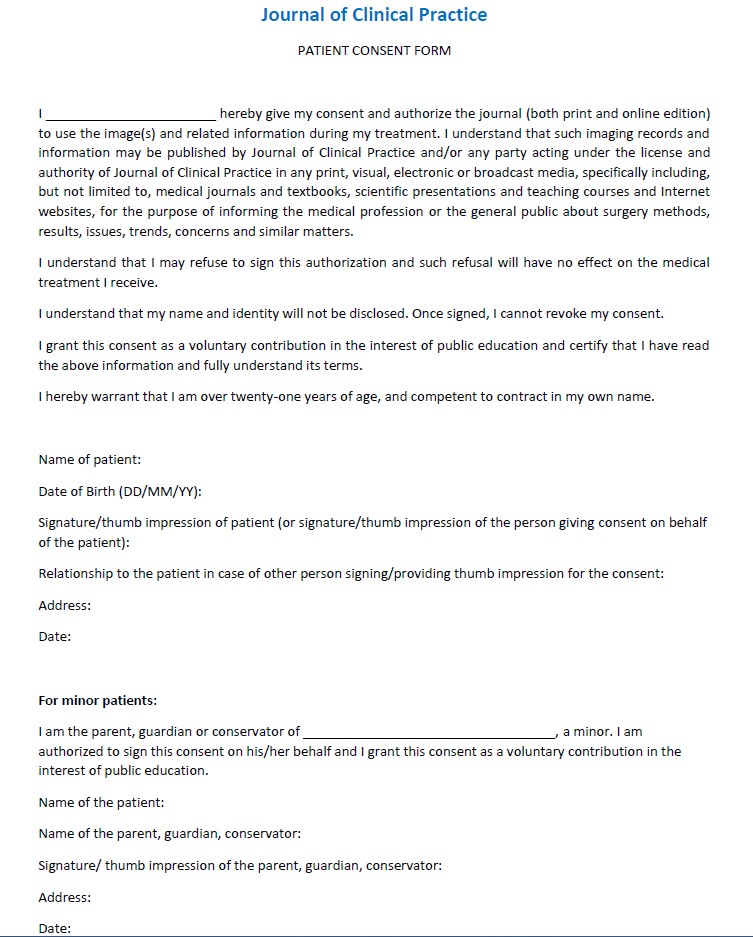
- The authors must obtain a signed patient consent form for every patient whose recognizable photograph will be used. If the authors do not supply this, the identity of the patient must be obscured before the image is published; this could interfere with the instructive value of the photograph.
- Ethics committee approvals and patient consent for participation for research studies must be submitted along with the article.
All papers reporting studies involving human participants, human data or human tissue must state:
- Name of the ethics committee or institutional review board that approved the study
- Approval number and date.
If the ethical approval is not required or is exempt, then a statement mentioning the same should be included in the submitted manuscript, with reasons for the same.
A statement about whether written or verbal informed consent was obtained from the patients to participate in the research should be included in the submitted manuscript. If the requirement for informed consent to participate has been waived by the Ethics Committee or Institutional Review Board (i.e., where it has been deemed that consent would be impossible or impracticable to obtain), please state this.
Protection of Patients' Rights to Privacy
Identifying information should not be published in written descriptions, photographs, sonograms, CT scans, etc., and pedigrees unless the information is essential for scientific purposes and the patient (or parent or guardian, wherever applicable) gives informed consent for publication. Authors should remove patients' names from figures unless they have obtained informed consent from the patients.
The journal abides by ICMJE guidelines:
1) Authors, not the journals nor the publisher, need to obtain the patient consent form before the publication and have the form properly archived. The consent forms are not to be uploaded with the cover letter or sent through email to editorial or publisher offices.
2) If the manuscript contains patient images that preclude anonymity, or a description that has obvious indication to the identity of the patient, a statement about obtaining informed patient consent should be indicated in the manuscript.
Sending a revised manuscript
The revised version of the manuscript should be submitted online in a manner similar to that used for submission of the manuscript for the first time. However, there is no need to submit the “Covering Letter” file while submitting a revised version. When submitting a revised manuscript, contributors are requested to include, the ‘referees’ remarks along with point-to-point clarification at the beginning in the revised file itself. In addition, they are expected to mark/highlight the changes as underlined or coloured text in the article.
Reprints
The journal provides no free reprints, since all articles are now available as free .pdf files on the website, from the day of publication of the issue, or sometimes even before.
Conflict of Interest
It is required that a list of disclosures from every named author is submitted alongside the manuscript. In it, each author should identify any financial or non-financial conflicts relevant to the article. If no conflicts exist, please state so in this section. Types of conflicts include: Consulting, Royalties, Research Support, Institutional Support, Ownership, Stock/Options, Speakers Bureau, and Fellowship Support. Any commercial entity whose products are described, reviewed, evaluated, or compared in the manuscript, except for those disclosed in the Acknowledgments section, are potential conflicts. Please click http://www.icmje.org/conflicts-of-interest to download a Conflict-of-Interest form.
Statement of Ethics
This journal adheres to the ethical standards described by the Committee on Publication Ethics and the International Committee of Medical Journal Editors. Authors are expected to adhere to these standards. For all manuscripts reporting data from studies involving human or animal participants, formal review and approval, or formal review and waiver (exemption), by an appropriate institutional review board (IRB) or ethics committee is required, as well as any necessary HIPAA consent, and should be described in the Methods section with the full name of the reviewing entity. All clinical trials must be registered in a public trials' registry. Denote the registry and registry number.
Patient Permission Policy
You must obtain a signed patient permission form for every patient whose recognizable photograph will be used. If you do not supply this, the identity of the patient must be obscured before the image is published; this could interfere with the instructive value of the photograph. Patient permission forms are available at www.jcp-vpims.com
Editorial and peer review process
The submitted manuscripts are duly acknowledged. An initial check is conducted to ensure that all author instructions are complied with and the guidelines for submission are followed. All communications regarding the manuscript with the Journal should be handled by one of the authors (assigned as ‘corresponding author’).
The editor runs the initial check, processes the manuscript for all the required components, and approves for moving to the next level. The manuscript may be returned to the author for corrections, if required, to conform to the journal instructions.
Once, the article passes the initial check, it will undergo editorial review. Here, the manuscript is checked for suitability and reviewed by the Editor-in-Chief. If it is found suitable, it will then be sent for peer review. Manuscripts are sent to a minimum of two independent expert reviewers to assess the scientific quality of the manuscript. All manuscripts undergo a double-blinded review process. The Editor-in-Chief makes a final recommendation (revise/ accept/ reject) on the manuscript based on the suggestions and comments of the reviewers. The authors will be informed of the decision. If a manuscript must be revised, the author(s) are asked to give a detailed response to the reviewers' suggestions and submit the revised manuscript for further review. This process is repeated till the authors, reviewers and editors are satisfied with the manuscript. The authors can track the progress of the manuscript by logging in the website.
The manuscript will be assessed for significance, originality, clarity, and relevance to the journal's scope and content, Studies that challenge previously published research or have negative results despite having sufficient power will also be considered. Manuscripts received from Editorial Board members will be screened by the Editor in Chief and sent to peer reviewers. Manuscripts authored by the Editor in Chief will be handled by the other editorial board members, and the final decision will be made by the Editor.
Article processing charges
There are no article processing charges for publication of an article in the journal.
Editorial contact:
Please contact the Editor in Chief for further queries at editorjcpvpc@gmail.com
Formats:
Patient consent form-