Preparing Manuscript
This journal page contains information regarding:
- Preparing manuscript
- Submission checklist
- Article checklist
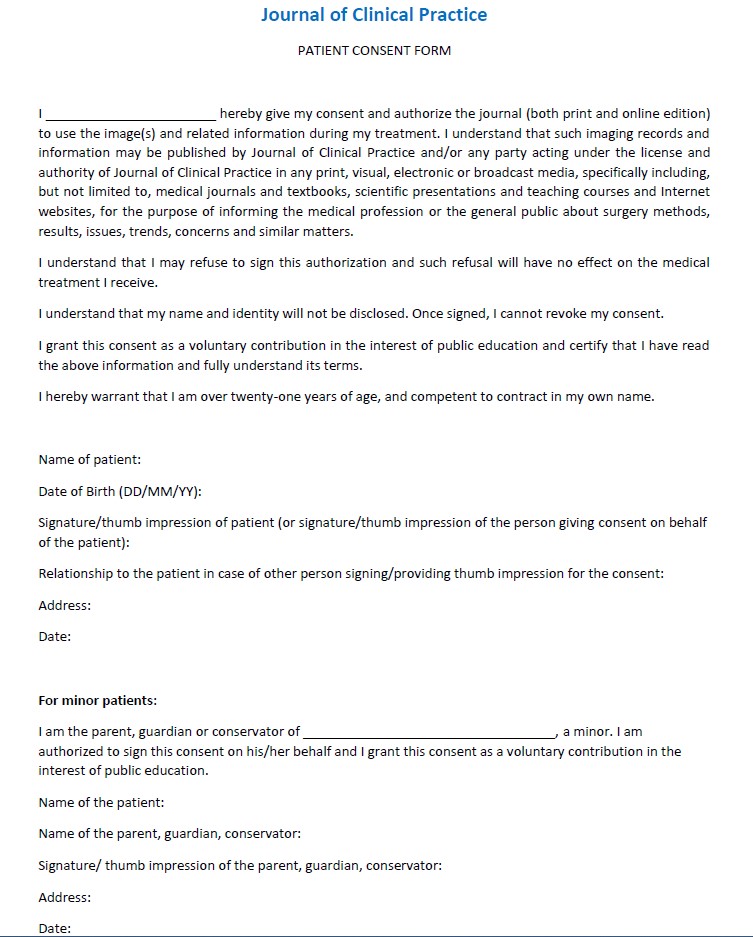
- Patient Consent Form
Preparing Manuscript:
Manuscripts must be prepared in accordance with "Uniform requirements for Manuscripts submitted to Biomedical Journals" developed by the International Committee of Medical Journal Editors. The uniform requirements and specific requirement of the Journal are summarized below. Before submitting a manuscript, contributors are requested to check for the latest instructions available. Instructions are also available from the website of the journal and from the manuscript submission site.
- Observational and experimental articles should be divided into sections, such as Introduction, Materials & Methods, Results, Discussion, References, Tables, Figures, Figure legends, and Acknowledgment.
- Use double spacing throughout.
- The language should be British or American English.
EQUATOR Network reporting guidelines (https://www.equator-network.org/reporting-guidelines/) must be followed depending on the type of study. At the time of submission, the authors should upload the relevant checklist for the specific study type. The EQUATOR wizard (https://www.goodreports.org/) can help you find the right reporting checklist and appropriate guideline for your type of study. Other resources can be found at NLM’s Research Reporting Guidelines and initiatives (https://www.nlm.nih.gov/services/research_report_guide.html).
Title Page
Title page details to be filled in at the time of uploading the article on Publishing.
Abstract Page
The length of the abstract should be restricted to 250 words for case reports and brief reports and 350 words for original articles. For Original articles the abstract should be structured with the following sub-headings: Introduction, Aim, Materials and methods, Results and Conclusion. Case reports and case series should have unstructured abstract (no sub-headings). No abstract is required in Short communications, Pictorial essay, Letter to Editor.
Key Words
These should be put in after reference to standard key words in MeSH terms provided by PubMed.
Introduction
State the purpose of the article and summarise the rationale for the study or observation. JCP does not required Introduction in Case report, Pictorial essay, View point and Letter to editor.
Methods
- Describe the selection of the observational or experimental subjects, such as patients and laboratory animals. Include the controls used for each experiment.
- Identify the age, sex, and other important characteristics of the subjects.
- Identify the methods, apparatus, and procedures in sufficient detail. Provide references to established methods, and describe briefly methods that have been published but are not well known.
- Describe new or substantially modified methods, give reasons for using them, and evaluate their limitations. Identify precisely all the drugs and chemicals used, including generic name(s), dose(s), and route(s) of administration.
- Reports of random clinical trials should provide information regarding all major study elements, including the protocol, assignment of interventions, and the method of masking.
- Authors submitting review articles should include a section describing the methods used for locating, selecting, extracting, and synthesising data. These methods should also be summarised in the abstract.
Ethics
- While reporting experiments on human subjects, you should indicate whether the procedures followed were in accordance with the ethical standards of the responsible committee on human experimentation (institutional or regional) and with the Helsinki Declaration of 1975 that was revised in 2013.
- Do not use names or initials of patients or hospitals and/or hospital telephone numbers especially in illustrative material.
- While reporting experiments on animals, indicate whether you adhered to the guidelines of an institution or national research council governing the care and use of laboratory animals.
Statistics
- Whenever possible, quantify findings and present them with appropriate indicators of measurement error or uncertainty.
- Report losses to observation resulting from conditions, such as dropouts from a clinical trial.
- Include a general description of methods in the Methods section.
- While summarizing the data in the Results section, specify the statistical methods used to analyse them.
- Avoid non-technical uses of technical terms in statistics. Define statistical terms, abbreviations, and most symbols.
Results
Present the results in a logical sequence in the text, tables, and illustrations. Do not repeat in the text all the data in the tables or illustrations. Instead, emphasise on or summarise only important observations.
Discussion
- Emphasise the new and important aspects of the study and the conclusions that result from them.
- Do not repeat in detail the data or other material provided in the Introduction or Results section. Include in the Discussion section the implications of the findings for the present and for future research and their limitations. Relate the observations to other relevant studies.
- Contributors should refrain from commenting on economic benefits and costs unless their manuscript includes economic data and analyses.
- Avoid claiming priority and alluding to work that has not been completed.
- State new hypotheses when warranted, but clearly label them as such.
- Recommendations may be included only if appropriate.
Acknowledgments
As an appendix to the text, one or more statements should specify
- The contributions that should be acknowledged but do not justify authorship,
- Acknowledgment of technical help; and
- Acknowledgment of financial and material support, specifying the nature of the support.
- Any paid support received from JCP in preparation of the manuscript.
References
- The references / bibliography should be in Vancouver style. For full details on this refer to the following link (Click Here)
- References cited only in tables or figure legends should be numbered in accordance with the sequence established by the first identification in the text of the particular table or figure.
- The titles of journals should be abbreviated according to the style used in Index Medicus.
- Use the complete name of the journal for non-indexed journals.
- Avoid using abstracts as references.
- Information from manuscripts submitted but not accepted should be cited in the text as “unpublished observations” with written permission from the source.
- Avoid citing a “personal communication” unless it provides essential information that is otherwise unavailable from public sources. In such an event, the name of the person and the date of communication should be cited in parentheses in the text.
- For scientific articles, contributors should obtain written permission and confirmation of accuracy from the source of a personal communication.
Tables & Figures
- JCP was initially an online only journal later went into print. It does not differentiate between tables and figures in numbering them as images are made for both. All tables and Figures should be numbered in Arabic numerals consecutively in the order of their first citation in the text (example Table/Figure 1, Table/Figure 2......)
- Tables should be self-explanatory and should not duplicate textual material.
- Tables with more than 12 columns and 30 rows are not acceptable.
- Place the explanatory matter in footnotes, not in the heading.
- Explain in footnotes all non-standard abbreviations that are used in each table.
- Obtain permission for all fully borrowed, adapted, and modified tables and provide a credit line in the footnote.
- For footnotes, use the following symbols in this sequence: *, †, ‡, §, ||, **, ††, ‡‡
- Labels, numbers, and symbols should be clear and of uniform size.
- When graphs, scatter-grams or histograms are submitted, the numerical data on which they are based should also be supplied.
- If photographs of people are used, either the subjects must not be identifiable or their pictures must be accompanied by written permission to use the photograph.
- If a figure has been published, acknowledge the original source and submit written permission from the copyright holder to reproduce the material. A credit line should appear in the legend for figures for such figures.
- The Journal reserves the right to crop, rotate, reduce, or enlarge the photographs to the desired size.
Protection of Patients’ Rights to Privacy
Identifying information should not be published in written descriptions, photographs, sonograms, CT scans, and pedigrees unless the information is essential for scientific purposes. The patient, parent, or guardian provides a written consent for the publication. After the consent has been obtained, it should be indicated in the article. A copy of the consent should be attached with the cover letter.
Sending a revised manuscript
Use instructions sent in email by the editor while asking for revision. It should be submitted at the JCP Publishing Portal only.
Submission Checklist:
- The submission has not been previously published, nor is it before another journal for consideration (or an explanation has been provided in Comments to the Editor) except as a brief Abstract in the proceedings of a scientific meeting or symposium.
- The submission file is in OpenOffice, Microsoft Word, or RTF document file format.
- Where available, URLs for the references have been provided.
- A file must contain authors/Institutional details and 2 suggested reviewers. The authors are entitled to make a request to exclude specific reviewers in this file.
- The main article text file must be highlighted (selected from the system) which should not have authors affiliation or recognizable information.
- The text is single-spaced; uses a 12-point font; employs italics, rather than underlining (except with URL addresses); and all illustrations, figures, and tables are placed within the text at the appropriate points, rather than at the end.
- The text adheres to the stylistic and bibliographic requirements outlined in the Author Guidelines.
- Author must submit patient consent form during uploading the article on the submit. Also, the article should not present any identifications of the patient to the public (if it is not the specific case on the facial abnormality). In fact, the patient privacy is still required in any situation. It is important in both ethical and legal dimension. Having signed consent form implies no right that the practitioner can present overt unnecessary exposure of the patient. Using “White/black bars to cover eyes” is one method of patient identity privacy.
- For help with submissions, please contact: editorjcpvpc@gmail.com
Article Checklist:
Covering letter
- Previous publication / presentations mentioned
- Source of funding mentioned
- Conflicts of interest disclosed
Authors
- Last name and given name provided along with Middle name initials (where applicable)
- Author for correspondence, with e-mail address provided
- Identity not revealed in paper except covering letter
- Presentation and format
- Double spacing
- Margins 2.5 cm from all four sides
- Page numbers included at bottom
- Title page contains all the desired information
- Running title provided (not more than 50 characters)
- Abstract page contains the full title of the manuscript
- Abstract provided (structured abstract of 250 words for original articles, unstructured abstracts of about 150 words for all other manuscripts excluding letters to the Editor)
- Key words provided (five or more)
- Introduction of 75-100 words
- Headings in title case (First Letter Capital Case)
- The references (Vancouver style) cited in the text should be after punctuation marks, in superscript with square bracket.
- References according to the journal's instructions, punctuation marks checked
- Send the article file without ‘Track Changes’
Language and grammar
- Uniformly British or American English
- Write the full term for each abbreviation at its first use in the title, abstract, keywords and text separately unless it is a standard unit of measure. Numerals from 1 to 10 spelt out
- Numerals at the beginning of the sentence spelt out
- Check the manuscript for spelling, grammar and punctuation errors
- If a brand name is cited, supply the manufacturer's name and address (city and state/country).
- Species names should be in italics
Tables and figures (with captions)
- No repetition of data in tables and graphs and in text
- Actual numbers from which graphs drawn, provided
- Figures necessary and of good quality (colour)
- Table and figure numbers in Arabic letters (not Roman)
- Labels pasted on back of the photographs (no names written)
- Figure legends provided (not more than 40 words)
- Patients' privacy maintained (if not permission taken)
- Credit note for borrowed figures/tables provided
Write the full term for each abbreviation used in the table as a footnote.
Patient Consent Form